Wednesday, August 5, 2015

British Evasion #9, August 6, 2015

British Evasion #9

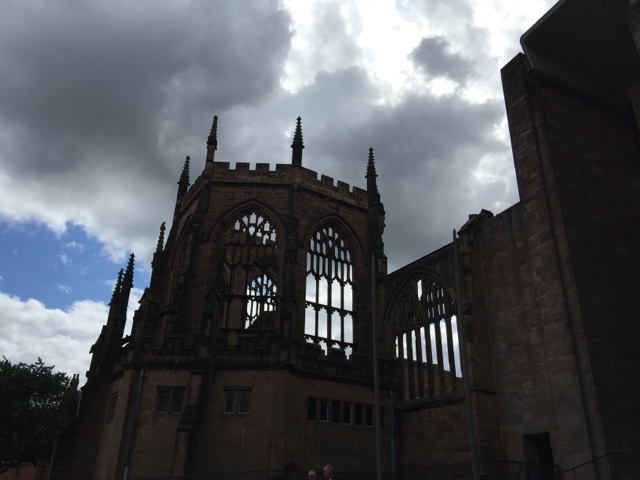
Seven days ago I stood in the midst of what is perhaps Britain's greatest and also most challenging war memorial, the bombed out ruins of Coventry Cathedral.  It has taken a full week for me to process the experience of that place and all the modern nightmare and eternal vision it represents.  Now I am ready to write and to share that experience, to share my own experience of Britain's greatest testament to the hope for peace and for reconciliation amongst all peoples and nations.  And I share it on a day when such a testament is called for, necessary even -- August 6, 2015, the 70th anniversary of the dropping of the atomic bomb on Hiroshima, Japan.


A Story We Can't Ignore

On the night of November 14, 1940, German Luftwaffe unloaded a massive aerial bombardment on the city of Coventry in the northwest of England.  Six hundred civilians died in the blitz which decimated much of the city and brought its medieval cathedral to rubbled ruins.

It was there, amidst the death and destruction, that a fateful decision was made which would transform the life of the Cathedral and its calling in the world. Resisting the desire for vengeance, the Cathedral's leader, Provost Dick Howard, directed that the words "Father Forgive" be inscribed in the still-standing walls of the burned-out Cathedral sanctuary.  Then, just weeks after the bombing, Howard stood inside the ruins and broadcast a Christmas Day message on BBC in which he said:

"What we need to tell the world is this: that with Christ born again in our hearts today, we are trying, hard as it may be, to banish all thoughts of revenge . . . We are going to try to make a kinder, simpler, a more Christ-like sort of world in the days beyond this strife."


Thus began Coventry Cathedral's new ministry as a symbol of forgiveness and hope.  That hope is embodied, Phoenix-like, in the very architecture of the Cathedral, as a stunningly modern and lucid new church rises up above the preserved walls of the old.  The two buildings, side by side make a stunning visual image -- one a memorial to the lives lost to the brutal cost of modern and mechanized weaponry, and the other a sign of the human community's ability to heal from the wounds of war.


Howard's words and the Cathedral's mission are at once inspiring and yet also disturbingly difficult.  But regardless of how unsettling Coventry might make us feel, in the end what is written in the Cathedral literature is deeply true: It is a story we can't ignore.

Service of Reconciliation

While at Coventry Irie and I attended the noon Service of Reconciliation in the new Cathedral nave.  The service is short and led by deacon who tells the story of the Coventry and then leads the congregation in a simple, yet deeply profound Litany of Reconciliation.

The Litany begins with a confession from St Paul's Epistle to the Romans, "All have sinned and fallen short of the glory of God."  Then there is a series of seven repetitions where the deacon names the deadly sins of hatred, covetousness, greed, envy, indifference, lust, and pride, each followed antiphonally by the congregation praying in unison, "Father, forgive."  The service ends with the deacon this time quoting Paul's Epistle to the Church at Ephesus: "Be kind to one another, tender-hearted, forgiving one another, as God in Christ forgave you."  The deacon then invites those present to take the litany and the whole Coventry story back with them to their home congregations.

As I sit here with the litany before me I notice what the liturgy is attempting to teach us in its form.  The service both begins and ends with a reminder that we are all sinners and in need of forgiveness. It is the Cathedral's way of teaching us that all reconciliation must begin and end with our own humility and confession.  This is the way toward reconciliation that Coventry seeks to teach the world; and it is the way toward reconciliation it invites us to go and teach also.

A Place of Images

Yet even more than liturgical words, Coventry is a place of liturgical images. And I leave you with two images from my visit.

The first comes from among the many striking pieces of art to be found in and around the Cathedral. There is the bold bronze of St Michael standing victorious over Satan -- a sign of the ultimate triumph of good over evil, right outside the entry way of the new Cathedral.  Then there is the Charred Cross, made from two medieval wood beams found in the shape of the cross after the Cathedral bombing.  And of course, the whole Cathedral itself is an astonishing work of beauty and art.


But the image I want to share is the sculpture by Josefina de Vasconcellos titled "Reconciliation".  It is the image of a man returning from war to meet his wife at home. Together, they bend or fall to their knees in loving embrace.  It is a beautiful image of both the heartache of separation and loss and also the joy of reconciliation. The reason I choose to share this image on this August 6 day is because as one of these sculptures stands near the back of the narthex in the new Cathedral another twin copy of the sculpture has been placed on behalf of the people of Coventry in the Peace Garden in Hiroshima.  Faceless, yet locked in the embrace of universal love, the couple of "Reconciliation" remind us of the inherent humanity of all those caught up in the tragedy which was World War II and all other wars before and after.


The other image I want to share I myself captured.  I was standing in the middle of the hollow ruins of the medieval Cathedral when I turned to look eastward and was startled to see a young child, perhaps two or three years old, sitting near the sanctuary altar, calm and still on the stone floor just beneath the words "Father Forgive".  The mother of the child was just getting up to come and scoop the little girl up as I rushed to capture the moment with my camera. I made it just in time and this image is for me now my favorite image of all the images from this entire trip to England.


I have had the week to reflect upon the meaning of this child, in all her beauty and innocence, sitting inside the canopy of a memorial to the great human cost of war, the words from our Lord and Savior somehow gathering the two together in a kind of harmony of space and time. What is the meaning of this moment -- of this image, of this child before this altar?  I cannot say what the meaning is for anyone else but for me.  That is the beauty of an image -- it speaks with more nuance and meaning than words.

But as I do speak for myself I speak of two more images which are evoked -- one from the Old Testament and the other from the New. The Old Testament image is from the Prophet Isaiah, who in a vision for a time yet to come spoke of the hope-filled day when wolf will live with lamb, leopard will lie down with goat, and calf with lion; and a little child will lead them all.  And the New Testament image comes from that scene where Jesus sits a little child between his disciples and tells them that if they wish to enter the kingdom they must change and become like the child.

And I wonder if that might be it for me -- the meaning of this child before this altar. That for me this child might have been sent there to as a sign to lead us into some more hope-filled time and kingdom yet unrealized, but only if we are willing first to change first. Only if we are willing to deeply confess our own sin personal and corporate and the cynicism we have about this world, its violence and God's ability to change us.  Only if we are willing to have our hearts changed and believe once again in the hope and prospect of forgiveness and reconciliation within ourselves, our families, our churches, our communities, and our world. In other words, only if we are willing to become like this child, and sit down silently at the altar, and wonder again at the meaning of the words on the wall:

"Father Forgive."

British Evasion #8, August 5, 2015

British Evasion #8

Today I want to take a bit of a break from my reflections on place and give just a snippet from one of the courses I am taking while here at Oxford.

The course is taught by Revd Dr Cally Hammond and is on the life and theology of St Augustine, the person who has had perhaps the greatest intellectual influence on Christianity aside from St Paul.

Augustine is most famous for two quotes -- both from his memoir "The Confessions".  The first comes as a kind of prayer of confession to God right at the beginning of the book and foreshadows for the reader what a wandering journey Augustine's journey will be: "Our hearts are restless, until they find rest in you."  The other comes later on, when the foreshadowing is past and the reader has some real sense of what a cad Augustine really was. It too is a prayer, he said he prayed along the broken road to faith -- "LORD, make me chaste -- but not yet."

For that prayer Augustine is extraordinary.  He is extraordinary, not so much for having prayed it, for many people have prayed the same; but for having had the guts to admit it, for very few would dare to do that. I know I wouldn't -- if I were ever to have prayed such a thing.

It's the guts of it, and partially the prurient curiosities of its readers have made "The Confessions" a classic.

Two images from Dr Hammond's class capture the Augustine journey -- or at least what we have projected on to it. One is from I don't know where, but is a little trashy and comic book heroic, showing Augustine tanned and presumably toned and with very blue eyes -- strange for an African. Dr Hammond compared this image to that of James Bond, who Raymond Chandler once said is the man every man wants to be and every woman wants to sleep with.  That's all mythic, of course, whether it be about Bond or Augustine; but it's part of the allure. And the allure with Augustine is the fact that his memoir leaves just enough unsaid that we can and have filled in the rest with all the seediness our prurient minds can possibly imagine.  We do this, then we say, "If someone like this can grow up and become a saint, then perhaps there's hope for me yet." 


And I suppose that was basically Augustine's point.

The other image Dr Hammond gave us comes from another time, another (and much better) artist, and is a depiction of another, much later moment in Augustine's journey toward sainthood.  The painter is Sandro Botticelli and the work is his fresco "Saint Augustine" painted in 1480.  This is the Augustine grown up, settled down, surrendered to faith in Christ, and now become a bishop -- Augustine of all people.  He is in his study, his mitre rests at his right elbow while books and other instruments of learned knowledge surround him.  These are artifacts from the journey, signposts of knowledge (scientia) which led him to wisdom (sapentia).  His right hand caresses his bosom; this too has meaning -- perhaps the ultimate meaning for Augustine. His heart has finally found rest, and found it in God.  Now he gazes upward toward whatever else is to come, toward the beautific vision.


The prodigal son has come home.  The old man, once young, is dead; the new man, now old, is made new.  This is the arrival of the life of the saint. And I want to leave it right there -- frozen in the beauty of Boticelli's depiction.

Yet, something nags at me deeply, something a close female friend and someone who always brings an interesting light to things said to me a few weeks back when I told her I would be taking this course on Augustine while in Oxford. "Augustine," she said, "did you know there is a novel written from the perspective the woman he dismissed -- his son's mother."

She was talking about Augustine's mistress and the mother of his son Theodatus, a woman who Augustine clearly loved, but who he felt he ultimately had to leave behind in order to go on to become a Christian. And no, I did not know that.  Well, maybe I had heard something about it, but I had never really paused and given it thought. Never read it.  Never read her account. Never heard her story. In fact, I don't even know her name. I don't know it because in all the pages of "The Confessions" Augustine never once mentions it -- never once mentions the name of the mother of his only child.

It unsettles me. It bothers me that I have never heard what she had to say about all that Augustine confessed, about all that God is said to have done in his life, about all that God is said to have done or not done in her own.  Like I said, it nags at me. I want to know why Augustine left her name out.  Out of shame?  Out of protection?  And whose protection? I want to know.  And most especially I want to know it from her perspective. I want to know what she has to say.  But that is not possible -- not really, but only in fiction like the novel my friend spoke of. No, the woman herself, whoever she was, is silent.

So, tonight I am thinking it is proper to add one more image to those Dr Hammond gave to us of Augustine. This is an image, not of him but of her, the woman who loved him and gave birth for him but was turned out for the sake of the church. This is an image of her.

And what is that image, how is it possible to have it since we don't know who she was or even what she was named?  The image I have chosen is simply an empty niche, a placeholder, a vacant reminder that she belongs in this story also, and that she has something to say to us also -- even in her absence.  Perhaps especially in her absence.


Monday, August 3, 2015

British Evasion #7, August 3, 2015

British Evasion #7

Yesterday's worship was at the University Church of St Mary the Virgin, which was founded in the 13th century and is one of the most famed churches in Oxford and, I have to say, the first church I have ever been to that served up sherry as a part of the reception right after service.


The congregation was friendly and the sermon by Canon Brian Mountford was at once quite humorous and deep.  It was about the connection between our speech and our theology and the way in which we talk and relate to one another communicates deeply theological assumptions.  I left inspired -- and inspirited.

Canon Mountford has a lot to live up to. Some of the greatest preachers and theologians have ascended the high and dark wooden pulpit St Mary the Virgin and preached truly historic sermons from its platform. John Wesley, the founder of Methodism, preached here more than once and John Henry Newman, who brought mind and soul back into campus ministry first in the Anglican Church and later in the Catholic, was vicar here in the mid-19th century. And here C.S. Lewis preached his famous "The Weight of Glory" sermon, wherein he described the force behind our human longing for the beautiful and the poetic and the sublime as but mere expressions of our ultimate desire to be caught up in the glory of God.


Here is a worthy snippet of Lewis's most-worthy sermon about our secret desire for God:

"I am trying to rip open the inconsolable secret in each one of you—the secret which hurts so much that you take your revenge on it by calling it names like Nostalgia and Romanticism and Adolescence; the secret also which pierces with such sweetness that when, in very intimate conversation, the mention of it becomes imminent, we grow awkward and affect to laugh at ourselves; the secret we cannot hide and cannot tell, though we desire to do both."

But not all things which have taken place in University Church have been so, well, sherry.  This was also the place for the trial of the Oxford Martyrs -- the Anglican bishops Hugh Latimer, Nicholas Ridley, and Thomas Cranmer.  The three were tried for heresy in 1555, found to be guilty of being sufficiently Protestant, and sentenced to be burned at the stake.

Cranmer, then Archbishop of Canterbury, might actually have escaped the fate of the other two as he was willing to recant and profess his loyalty to the monarch and to Rome.  But several months later, as he was preaching in University Church he suddenly diverged from his prepared and printed text, denounced the pope, and declared himself indeed a Protestant.  He was then yanked from the pulpit, led to the city centre and burned like the other two.  As the pyre flames grew near he is said to have plunged his right hand first into the fire as an act repentance for having originally signed his recantation.

A memorial to all the martyrs of those bitter years -- Protestant and Catholic -- now stands solemnly inside the nave. I set just behind and looked over it throughout the Sunday service.


How can this be I wonder?  How can a place of such spiritual richness and life also be so vile and full of death?

Then I remember the parable that Jesus taught -- about the wheat and the weeds growing up together in the field and how it's impossible to separate the two until the harvest comes; and how the wheat symbolizes the good of the earth while the weeds the evil, and there they are together in one single place, in the University Church of St Mary the Virgin and everywhere else -- every field, every church, every city, and every country -- also.

And then it makes clear sense what Lewis was saying in that famous sermon -- how he ended it with a sobering and unsettlingly-true reminder about just how glorious or depraved the destiny of humanity really is:
"It is a serious thing to live in a society of possible gods and goddesses, to remember that the dullest and most uninteresting person you talk to may one day be a creature which, if you saw it now, you would be strongly tempted to worship, or else a horror and a corruption such as you now meet, if at all, only in a nightmare."


Sunday, August 2, 2015

British Evasion #6, August 2, 2015

British Evasion #6

Today my friend and partner in the Gospel Stephanie Nash will be preaching at Second B. I am grateful for her many gifts and glad that I am a part of a church which believes in the role of women in ministry.

This leads me to reflect on the continually developing role of women clergy in the Church of England.

Just before my arrival here in July, the Rev. Joyce Bennett passed away at 92 years old.  English by birth, Bennett was sent as a missionary to Hong Kong in 1949 and was ordained by the Hong Kong branch of the Anglican Communion in 1971.  After her ordination, she returned to England and shepherded a Chinese immigrant congregation inside St Martin in the Fields.

Though Bennett kept a low profile when at first back home -- she had the title "Reverend" printed on her business cards only in Chinese and not in English -- eventually she became more public. In 1986 she presided over Eucharist a well-publicized meeting of the Movement for the Ordination of Women (MOW), which led to denunciation from much of the Anglican hierarchy.  But the tide was turning and as I have made my way in and out of churches all over England women priests are everywhere.


I like what I read Christina Rees, of WATCH (Women And The Church), an advocate for women clergy in England and a friend of Bennett's said about Bennett upon her passing:

"Because she was such a lovely, measured, and inspirational person, she didn't just make women's ordination look like a good thing.  She made it look normal, which was the best thing she could have done for the church."

That sense of normalcy did indeed help change things here in England -- and dramatically so. In January of this year Libby Lane was consecrated bishop of Stockport and the first female bishop in England.


Of course, not everyone is on board with female priests.  There was what looked to be a dramatic scene at Lane's consecration where a clergyman interrupted the proceeding, saying "not in the Bible."  (Watch here: http://www.bbc.co.uk/news/uk-politics-30974547) But Archbishop of York John Sentamu, who was presiding over the service was prepared and handled the whole affair with dignity and repose -- the patently British way indeed.

All this brings me to a quote from Canon Angela Tilby, who will be the program (or as they spell it here, "programme") director for my time in Oxford.  Preaching at a service at St Paul's Cathedral marking 10 years of ordination in the Church of England, Tilby said, "Women priests have not unhinged the world."

No, they haven't. They've just made it all look normal.

That's what Stephanie will do today too I'm sure.

Saturday, August 1, 2015

British Evasion #5, Part 3 of 3, August 1, 2015

British Evasion #5, Part 3 of 3


After the cathedral has done its job in reminding us of our proper place in history and cosmos, it then moves us in the opposite direction. Like the liturgy within, the whole thing begins in genuflection towards the altar and the confession of our unworthiness but then raises us up with ancient and holy words, "Lift up your hearts," and the invitation to come and partake -- to participate in the whole drama. There is a summons within the cathedral; the building itself is a call to worship and to work. The very walls cry out for us to rise and do and be about the building of something greater than ourselves.

Those common laborers come to mind, the ones who laid the stonework, or the skilled masons who carved the gargoyles, and the artists who accepted the daunting task of sculpting saints.  There was the pre-imminent architect Christopher Wren, who after the Great Fire of 1666 built 52 churches, including the masterpiece of St Paul's Cathedral.  There was the man and his great monumental vision for the glory of God; and then there were the myriads of now-forgotten workers who raised it up and kept it standing.


These cathedrals are a testament, a symbol of the will of a people and the eternal hope for the city of God.

I am thinking now of the night of December 29/30, 1940 as German bombers continued on their months-long blitz of Britain and Northern Ireland. For 57 nights straight Luftwaffe dropped bombs on the city of London. In all, a million London homes were damaged or destroyed, and 20,000 Londoners were killed.  Yet the Cathedral was spared, primarily because Churchill ordered a special team of firefighters to stand watch atop the dome.  They threw flaming incendiaries off of the roof of the cathedral, as men like them did the same in Canterbury and in other cities throughout the United Kingdom.  And there, somewhere in the early hours of December 30, photographer Herbert Mason stood atop the roof of the "Daily Mail" and shot an iconic image "St Paul's Survives" that captured the not only the monumental resilience of a building but also that of a whole nation.


Who were those firefighters?  Their names, recorded now in some esoteric book about the London Blitz, will one day be forgotten once their children and their children's children pass away.  But the building will still stand. The church will remain.


These cathedrals are a mirror, a look into the soul of a people, their values, their dreams, and their aspirations. They keep us looking up, towards the eternal, towards the coming of the great one on the clouds, towards tomorrow.  They keep reminding us the answer to the psalmist's question, "What is man?"  And his rhetorical answer, "a little lower than the angels, and crowned with glory and with honor."

Heir of the kingdom 'neath the skies
Often he falls, yet falls to rise;
Stunned, bleeding, beaten back,
Yet holding still to the upward track,
Playing his part in creation's plan,
God-like in image, this is man.

Howard Thurman

Friday, July 31, 2015

British Evasion #5, part 2 of 3, July 31, 2015

British Evasion #5, part 2 of 3


Another opposite, yet mutually true set of truths I have experienced while visiting these four (now five) English cathedrals is the contrast between the mortal and the immortal.


When you glance at or walk into a cathedral one's eyes are immediately drawn up toward what is, metaphorically speaking, the heavens.   A holy quiet is intuitively ushered into one's body and spirit. Walk into St Paul's Cathedral, with its marble floors, and one can't help but be self-conscious of the steps he or she makes. There is metaphor there for sure. And words.  Words seem so small in places like these. I can hardly imagine what trepidation a preacher must feel as the steps to the elevated pulpit are ascended. Who would dare to even speak a sound in such a place as this?  "The LORD is in heaven, and we are on earth; so let your words be few," the wisdom writer says.  Even better, let them be none.

"The LORD is in His Holy Temple
Let all the earth keep silence before Him."

Or, as we sang during last Sunday's worship service at St Paul's:

"Let all mortal flesh keep silence
And fear and trembling stand . . ."

Perhaps this conscious sense of my own mortal flesh has been most evident to me within the medieval sandstone walls of Canterbury Cathedral.  Here, amidst stones hewn prior to Henry IV, one really gets it -- how small the part we have been cast in such a long drama.

You see this especially at the focal center, just beyond the choir (or as it is spelled in Canterbury "quire").  There sits the throne of the archbishop, beautifully carved from what looks to be oak and couched in red cushion.  And large, very large -- a symbol not so much of the largeness of the men who have set here or their character, but of the office and the task, greater than one man could ever live up to. As former Archbishop of Canterbury Rowan Williams, has said, "It is physically impossible to fill this throne, which shouldn't surprising because it's spiritually impossible."


And then, as if to underscore the whole thing, sits just adjacent from the archbishop's seat a stunning, if a bit chilling, sarcophagus of one of the long-deceased archbishops. Atop is a beautiful image of the archbishop fully festooned in all his ecclesiastical regalia and surrounded by miniature saints and angels, praying over and tending his tomb.  Then the credentials.  "Here lies Henri Chiceli, Doctor of Laws and Chancellor of England, Henri V's Archbishop."  


But then, beneath that image is another, even more striking -- disturbing even in its depiction of a naked and emancipated body.  "Born a pauper, I was raised up to be Archbishop; Now I am laid low to be food for worms."  Then the real kicker, just to make the whole point as personal as possible: "Here is my tomb; look into your mirror."


"What is man?"  Dust we are; and to dust we shall return.  And long after our mortal bodies have returned to dust (thanks in part to those worms), the stones of cathedrals will still stand, and our grandchildren's grandchildren will have there turn to be born and rise up to whatever they will be.

And so these cathedrals are a reminder to look up to the heavens in humility and behold our part in the play, and to be mindful of our steps and graceful with our script as we make our way across the stage.

Thursday, July 30, 2015

British Evasion #5, July 30, 2015, part 1

British Evasion Day Eight, part 1

And I saw no temple in the city, for its temple is the Lord God the Almighty and the Lamb.

Revelation 21:22

For thou hast made him but little lower than God, And crownest him with glory and honor.

Psalm 8:5


We have now so far been to three cathedrals -- St Paul's, Canterbury, and Coventry -- and each of these visitations have stirred within me a number of divergent and even conflicting theological and anthropological thoughts, all of which are ultimately resolved within me by an overwhelming and deeply resonant sense of spiritual awe and wonder.

The most immediately identifiable conflict I have within me is perhaps more taught than it is natural -- in other words it is more of a thought than an intuitive feeling. It comes from my Baptist forbears' conviction that the Temple is not an edifice but a Person, and Church is not a building but a people.  Rejecting all the majesty and mystery of the medieval church, the Baptists and Congregationalists who joined together to build the first church I pastored built a simple and unembellished meeting house where 175 years later some old timers still spoke of "Sunday go to meetin'" and never Sunday go to church.  For these early 19th century Protestants, the church met in the building, but was never the building itself; and I'm sure they could quoted chapter and verse from Revelation where John said he saw no Temple in his vision of heaven because God Himself will be the Temple.

But it's not just Puritans and Separatists from centuries past who cast suspicion on the temples humanity has made for its gods.  From another very different spiritual tradition, the 20th great century Jewish mystic Abraham Joshua Heschel himself, in a widely influential reflection on the meaning of Sabbath contrasted the difference between sacred space and sacred time, locating the human need for holy space in the lower order of spiritual evolution. "The primitive mind finds it hard to realize an idea without the aid of imagination," Heschel wrote, "and it is the realm of space where imagination wields its sway.  Of the gods it must have a visible image; where there is no image, there is no god.


To speak of something as "primitive" is not in itself to say anything negative.  It does, however, imply an undeveloped and even infantile state. Heschel's thesis was clear -- a religion in need of temples is for a humanity only just born.

Heschel's critique of temple religion is, of course, as old as the Jewish Prophets.  And it was a very similar statement that got Stephen, the first Christian martyr killed, when in the shadow of the Jerusalem he dared to say that God does not dwell in houses made by human hands and quote the prophet Isaiah in saying, "Heaven is His throne and the whole earth just his footstool," [my translation].

All of this is, of course, true.  God surely cannot be held in a house or temple or even in the whole earth or cosmos.  And yet, there is something within me -- something "primitive", to use Heschel's term -- which is attracted to or perhaps by spiritual space. The loft and grandeur of these cathedrals draw me like a moth to a flame. There is awe and there is wonder, and there is a sense that art and architecture were dreamed for such a sacred calling as this. Just as all things take place, so holy things take holy places. And these cathedrals, though built and maintained by fragile and sinful men, are still nonetheless holy indeed.


So I am thinking again and more deeply about the the book of Revelation and John's vision. It is true, there is to be there no Temple because God Himself will be our Temple. But it is also true that there will be no sun and no moon because God himself will be our Light.  In other words, our needs there in heaven are going to be different from our needs here on earth -- both physical and spiritual.  And that brings me back yet again to the folk wisdom of my pastor Charlie Johnson which I mentioned a few days earlier, "This ain't heaven -- it's church."

This ain't heaven -- it's earth.
Where stars and sun and moon light our way,
Beckoning us on to believe there is such a thing
As Very Light of Very Light
And Temples Made with human hands lift our eyes
To behold with primitive men
A glory too great for marble and stone
Yet humble enough to meet us there, nonetheless