Tuesday, April 3, 2012

The deaths of two Martins: A Call for a New Nonviolence


Rev. Dr. Martin Luther King, Jr. died forty-four years ago today. Given the momentous life Dr. King lived, and the place of honor he has come to receive, it is easy to forget how young he died - only 39 years of age. Like Jesus of Nazareth, Dr. King was struck down before even turning forty, and yet like his Lord and Savior, his life, legacy, and dream lives on.

As we solemnly remember Martin Luther King's death this year, we cannot help but also having in our minds another Martin who died too soon - Trayvon Martin, who was killed by George Zimmerman, a neighborhood watch captain was appointed to help protect the neighborhood after a rash of breakins. For reasons we are all speculating about, Zimmerman found Martin suspicious, followed him, and claims he was then attacked by him. When police arrived Martin was lying in the grass in a pool of blood.

We will never know exactly what happened between Martin and Zimmerman which led to Martin's death. Whatever did happen, we can all agree it ended in tragedy. I would like to suggest this tragedy underscores our need to learn more creative and non-violent responses to crime, suspicion, fear, insecurity, and intimidation - the kind of creative and non-violent practices Dr. King himself embodied throughout his life and ultimately even up to the day of his death.

Most people know that the King-led Montgomery Bus Boycotts of 1955 were Gandhi-inspired demonstrations of non-violent, direct resistance to evil. It was Dr. King's insistence on the power of non-violence which began the Civil Rights movement in earnest. What most people do not know, is that it was Dr. King's continued belief in the power of non-violence which brought him to Memphis on that fateful day thirteen years later.

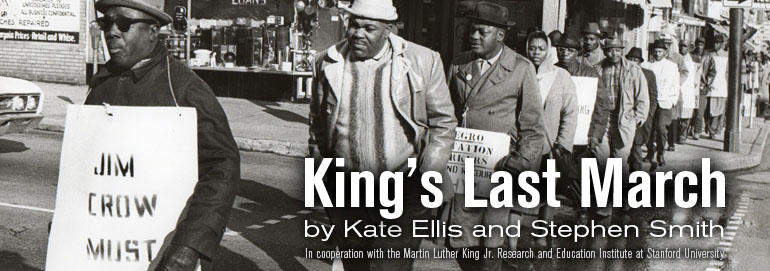
In March of 1968, Dr. King was planning a "Poor People's Campaign" where he intended to bring busloads of poor people to the Mall on Washington, DC in a massive demonstration against policies which Dr. King saw as keeping millions of Americans endemically poor. Prior to the Washington campaign, however, Dr. King answered a plea from Rev. Jim Lawson to come and assist Memphis sanitation workers - mostly black - in a protest for more decent pay and working conditions. On March 28 Dr. King led an ill-prepared march which was interrupted by rioting and mass looting. Dr. King left the march and soon Memphis and 4,000 National Guardsmen were called out to quell the rioting.

The March 28 march would be King's last. It was perhaps the nadir of his involvement with mass demonstrations. Never before had a march led by Dr. King broken out in violence among his own ranks. The lack of training among the marchers on March 28 is rightfully considered a blunder on the part of the King and the other march leaders. Critics seized on this as an example of Dr. King's waning ability to lead mass groups of young blacks. If this is what happened in Memphis, what would happen in Washington?

Dr. King needed to act quickly to come back to Memphis with more staff trained at leading non-violent demonstrations in order lead a more disciplined march through Memphis, lest both the campaign in Memphis and also in Washington be lost. This was the reason why Dr. King was back in Memphis on April 4th - to continue his insistence in the power of nonviolence and to put it into better practice.

For as Rev. Dr. Benjamin Elijah Mays said in his eulogy at Dr. King's funeral just five days later, "[Dr. King] went up and down the length and breadth of this world preaching nonviolence and the redemptive power of love . . . Nonviolence to King was total commitment not only in solving the problems of race in the United States, but in solving the problems of the world."

George Zimmerman insists he does not have a race problem. He did, however, have problems for which more creative and nonviolent solutions must be sought out. Breakins were a problem and a neighborhood watch program was a good response. Vigilance is needed; vigilanteeism is not. The purpose of watch programs is to reduce incidents in a neighborhood. Zimmerman failed flat out on that and it came at a great cost for him and an even greater one for Martin. On the flip side, if we take Zimmerman at his word and suppose he is telling the truth when he says Martin attacked him, certainly we could understand the desire to defend oneself from a perceived threat. Yet, I have to wonder what else would be expected of Martin in response to being followed by an armed man? Run away? That's pretty unlikely.

The killing of Trayvon Martin underscores just how desperately we need alternative solutions to the violence in our streets today. Dr. King, Rev. Lawson, and the other leaders of Gandhian resistance, knew that nonviolent direct action takes creativity and discipline that must be learned and practiced in advance of an incident. Turning the other cheek, and walking the extra mile do not come naturally, but they are necessary tactics for survival in volatile situations.

Perhaps what is most needed is a new generation of such leaders who can teach neighborhood watch groups disarmed and disarming ways to deal with criminals in their neighborhoods. Likewise, they could teach young people like Trayvon Martin the skills necessary for engaging antagonistic situations without either suffering the indignity of running or the danger of fighting. What we need is the "third way".

The Quakers have a saying: "If in seeking to kill the beast, you become a beast, then beastiality has won." We must confront the beasts, but we cannot confront him by becoming him. What we need is another way; the nonviolent way - what Dr. King called "the only road to redemption."


For a great essay from King on nonviolence please see his article "Nonviolence: The Only Road to Redemption" at:

http://teachingamericanhistory.org/library/index.asp?document=1426


For more information on King's role in the Memphis sanitation workers' strike and the place where I got much of the history for this essay see and listen to:

http://americanradioworks.publicradio.org/features/king/

Friday, March 30, 2012

Prodi-Gay Son Returns to Ordinary Family


Correction: The after-film discussion will be with Robert Peaslee, assistant professor of Mass Communications at Texas Tech, and not Bill Kerns.

Today I interviewed actor and Lubbock native Chad Miller about his role in the indy film An Ordinary Family (trailer above). The film depicts the lives of a gay man, his priest brother, and their struggle to reconcile with one another.

The film is hyped as, "A cross between Modern Family and Guess Who's Coming for Dinner". In our interview Chad and I talk about some of the religious themes in the film. Chad says the story depicts what he called the return of the "Prodi-Gay Son". Whoa.

The film shows as a part of the Flatland Film Series next Saturday, April 7 at 7pm at Firehouse Theatre. Flatland Film Series is presented by The Louise Hopkins Underwood Center for the Arts.

A conversation will follow between Chad and Lubbock Avalanche Journal Arts and Entertainment editor and Second B member Bill Kerns.

I will be there no doubt.

Click here for my interview with Chad.

Wednesday, March 28, 2012

Remembering a Moses at Mt. Nebo

Below is an excerpt from my Holy Land travelogue. Though Second Page articles are usually not publications of thoughts I have shared in sermons, I thought many former Second Ber’s across the country who knew Everette Abernathie would appreciate reading it. Everette was truly a giant in our church. He is already missed dearly.

We got word last night that Everette Abernathie had passed away. Everette was the first person to sign the charter on our church and the man behind the Sick Children's Clinic for all these years. A true pillar.

I once listened to the tape of the memorial service Second B had for Bob Hearn, our first pastor. Charlie Johnson read from a letter Bob had written to Charlie upon his arrival as Second B's third pastor in 1990. "Trust the spirit of Anita and trust the Spirit of Everette," Bob told Charlie. Now both Anita and Everette are gone.

I hate it that I am missing Everette's funeral tomorrow. But if there were any other place around the world I might wish to be it would be right where we were today at Mt. Nebo. The Moses on Mt. Nebo story is the story of the great leader whose time has come. He goes up Mt. Nebo, sees all of the Promised Land, but cannot go over Jordan with the rest of the Israelites. Instead, he goes to be with the LORD.

On Mt. Nebo today the Catholic priest indulged our group by giving us a few minutes in the chapel "for a Mass." We began with Becky Corley reading a call to worship from the Book of Common Prayer's preface for All Saints Day based on Hebrews 11: "Who, in the multitude of thy saints, hast compassed us about with so great cloud of witnesses. . . ."

I then told the group about going to see Everette in his room at Crown Point Rehabilitation for what would be the last time. He was asleep in his room and so I sat down at his bedside and held his hand and began to sing all the hymns I could remember. I sang Amazing Grace, and Sweet, Sweet Spirit. Everette was only semi-conscious. I didn't know if he could hear me. But when I sang the old Negro Spiritual Swing Lo, Sweet Chariot, Everette's mouth opened and his tongue began to move with the rhythms of the song:

I looked over Jordan,
And what did I see,
comin' for to carry me home?
‘Twas a band of angels comin’ after me,
Comin’ for to carry me home.
Swing Lo, Sweet Chariot, comin’ for to carry me home.


There in that little chapel, we sang that spiritual and then I read from Deuteronomy 34:8: "The Israelites wept for Moses in the plains of Moab thirty days, then the period of mourning for Moses was ended." And then I added the first word of verse 9, "Joshua." I talked about how this last chapter of the book of Deuteronomy is a hinge. It serves not only as the final chapter of the whole Exodus story, it also serves as a segue into the first chapter of next book and next generation: the Joshua generation. Deuteronomy describes how before Moses went up Mt. Nebo, he first sang a song. Then he gathered all the Israelite tribes before him and he blessed them — he blessed the next generation.

At the conclusion of the service I invited everyone to come forward and receive an anointing with oil upon their forehead. "Moses gave his blessing to the Joshua generation," I said. "Now Everette gives his blessing to us. The chariot has swung lo; we wear the mantle now."

After the service we went out to the western edge of Mt. Nebo, just above Mt. Pisgah. The day was hazy and so we could not see all that Moses saw. In fact, we could see very little really. Yet, we could see enough; the rest we took on faith. In other words, we trusted the Spirit.

And now we move forward. We are the Joshua generation, moving from the wilderness over Jordan into the Promised Land. And we are blessed to carry Everette's song with us:

If you get there, before I do, Comin’ for to carry me home
Tell all God's children, I'm comin’ too
Comin’ for to carry me home.

Monday, March 26, 2012

Remembering Innocents


Last night Second B's sanctuary was the site for a vigil to remember the hundreds of children who were killed by child abuse in 2011. We co-hosted the event in partnership with Family Guidance and Outreach Center of Lubbock and about 300 bikers.

Yes, you read that right, bikers - as in motorcycles, bandanas and lots and lots of leather. Interestingly, the biker community has really rallied around the cause of child abuse here in our community. Whenever someone is on trial for child abuse, bikers clad in black leather wearing bandanas and goaties show up in court to watch. The point is clear - if you mess with kids, you mess with bikers also.

Before my invocation, I told those gathered that they didn't look like the usual Sunday crowd here at Second B. They laughed in agreement.

But, I said, it is appropriate that a church be the site for this kind of event. I told them about having just come from Bethlehem, and the church of the Nativity, the place where Jesus was said to be born. Beneath that church there is a cave, which serves as a crypt. And there is buried there in that crypt the bones of the children who were killed by King Herod when he came after baby Jesus and ended up killing all the children two and under in and around Bethlehem.

"Nowhere else in the history books is that event chronicled," I said, "except in the Bible. The people of God remember."

The Church calls that event the Slaughter of the Innocents. Truly all those names which were read and remembered were indeed innocent. And truly we will continue to remember, until the slaughter of innocents ends. Because when you mess with kids, you mess with bikers - and you mess with the Church also.

Saturday, March 24, 2012

Redeeming Mulatto

For those who are mixed race or have mixed race children, here is a theological reflection by Brian Bantum (black/white) on the meaning of Christ's mulatto (God/human) nature.

Redeeming Mulatto: Race, Culture, and Ethnic Plurality from Quest Church on Vimeo.

Wednesday, March 7, 2012

We Have Seen Emergence Christianity & It Was Once Us

I began last week's reflection with a quote from our 2012 Adult Retreat leader Phyllis Tickle: “If ever I saw an Emergence bunch of folks, it's you all!”

That makes me feel good. It's exciting to think someone from the outside looks at us and thinks we are about the things that make for a cutting edge church. Everybody likes to be seen as being relevant to the times. Thank you. Phyllis.

And then she hit us with a blindside. She called us the Jerusalem Church.

The Jerusalem Church?

In the book of Acts, the Jerusalem Church was the church led by James the brother of Jesus and a number of other conservative Jewish followers of Jesus. They were the ones who took issue when newer churches like the one at Antioch started allowing Gentiles to come into their fellowship without having to observe Jewish customs like circumcision and dietary law. The Jerusalem Church was the conservative "home church," while Antioch was the cutting edge, Emergence church.

How can this be? How can we be both an Emergence church and also the Jerusalem Church?

The answer is time. If you remember, when the Jerusalem Church was first founded at Pentecost, it was the cutting edge, church of the Emergence. But a quarter of a century passed between that day and the time the Antioch Church was founded. The same is true for us at Second B. When we were founded in 1958, we did indeed have all the charismatic characteristics of Emergence Christianity (you can read these in last week's article). We still do. But now we also have the institutional characteristics of a Jerusalem Church — an aging congregation, high operational costs, established forms of organizational structure, decision-making, and worship —which are said to define "who we are", etc.

None of this is bad in and of itself. It's simply what happens to the Jerusalem Church in the pages between the Day of Pentecost and the founding of the Church at Antioch. The task of a Jerusalem Church like ours is to remain open to new movements of the Holy Spirit which will certainly move us from "who we are" in the present toward what God calls us to be in the advent future.

We call such movements "renewal" — a making again. Renewal is the re-making of the Jerusalem Church, not into the Church of Antioch, but rather again into the Church of Pentecost — a church ready to be born again by the wind and flame of God's power.

You can read more about what this renewal might mean for Second B next week.

Thursday, March 1, 2012

We Have Seen Emergence Christianity & It Is Us

Phyllis Tickle said it herself: “If ever I saw an Emergence bunch of folks, it's you all!”

And that is no doubt true. We were born in 1958 and set out very early to be a different kind of Baptist church. Let me name just three such ways in which we were different that immediately come to mind and which embody Emergence Christianity.

Tickle talks a lot about the "erosion of Sola Scriptura" in the church. She says the end of slavery, the evolution of women's roles in society, the prevalence of divorce, and now the traction of gays gaining more acceptance in society have all worked to erode the notion that we must abide by the strict letter of the New Testament. Very early on we affirmed our love and respect for the Scriptures but freed ourselves from wooden interpretations which suffered no women to speak in church (much less pastor one) and excluded divorcees and gays from the life of our church. Of course, we have no slaves in our pews.

Tickle also says we are entering into a "hyphenated" world where strict denominational lines will be blurred. Early on, we recognized that Jesus has "sheep not of this fold" (John 10:16) and therefore embraced Christians of other denominations. Accepting non-Baptist baptisms — it was called "alien immersion" — was one thing that got us into hot water with other Baptists way back. As our former senior pastor Hardy Clemons once put it to me, "We thought it was more important to be Baptist than to be Southern Baptist, and more important to be Christian than Baptist at all." This kind of attitude allowed us to adopt the liturgical calendar and various liturgical elements in our worship which we share with Christians across denominations, geography, and even time.

Finally, Tickle suggests that the core theology which is driving Emergence Christianity is Micah 6:8 theology. I like it in the King James: "He hath shewed thee, O man, what is good; and what doth the LORD require of thee, but to do justly, and to love mercy, and to walk humbly with thy God?"  Micah 6:8 theology rejects Christian triumphalism that so colored Christian missions like that of the Crusades and replaces it with an open-handed witness that seeks to show Christ through our efforts in building the kingdom of God in our own community and beyond.  In other words, we are not just about getting the world saved for heaven, but rather about seeking to bring God's kingdom "on earth as it is in heaven." I can think of no more beautiful ways that has happened than through our Sick Children's Clinic since 1961, and, more recently, our  St. Benedict's Chapel, Kids Hope, and jail ministries.

Given all this, I think Stephanie Nash nailed it on the head when she said something like, "At Second B, we may already be an Emergence church — I don't know if that is good news or bad." It's good news of course if we want to feel like we've been steadily moving with the Spirit through our past. It may be disappointing news, however, if we were looking for a magic bullet which would rip open a hole to our future.

Instead, what we have been given is just a peep hole into that future. Next week, I will try to peek through that hole and tell you what I think I see. And the surprising thing is, the lens I'm going to use will come out of our past — the book of Acts and another book The Incendiary Fellowship, written by Elton Trueblood in the 1960’s, in which there is a chapter provocatively titled "Conditions of Emergence."